

Graph Retrieval-Augmented Generation bridges the gap between semantic search and structured knowledge, enabling Large Language Models to connect the dots across massive, disparate datasets.
Vector DB vs. Knowledge Graph
To understand GraphRAG, we must understand its foundation. Standard RAG relies heavily on Vector Databases, which excel at finding semantically similar chunks of text. However, they struggle to understand explicit relationships. Knowledge Graphs (KGs) represent data as Nodes (entities) and Edges (relationships), providing deterministic, structured pathways for reasoning.
Vector Database
Finds data based on meaning and proximity in high-dimensional space. Fast, unstructured, but lacks exact factual precision and global context.
Knowledge Graph
Stores data as explicit entities and connections (“Company A” -> OWNS -> “Product B”). Excellent for multi-hop reasoning and explainability.

Problems GraphRAG Solves
Standard RAG systems often fail at “multi-hop” questions—queries that require synthesizing information across multiple documents. GraphRAG integrates the Knowledge Graph into the retrieval pipeline, allowing the LLM to traverse relationship pathways before generating an answer. This dramatically reduces hallucinations and enables “global” corpus summarization.

Challenges of Knowledge Graphs
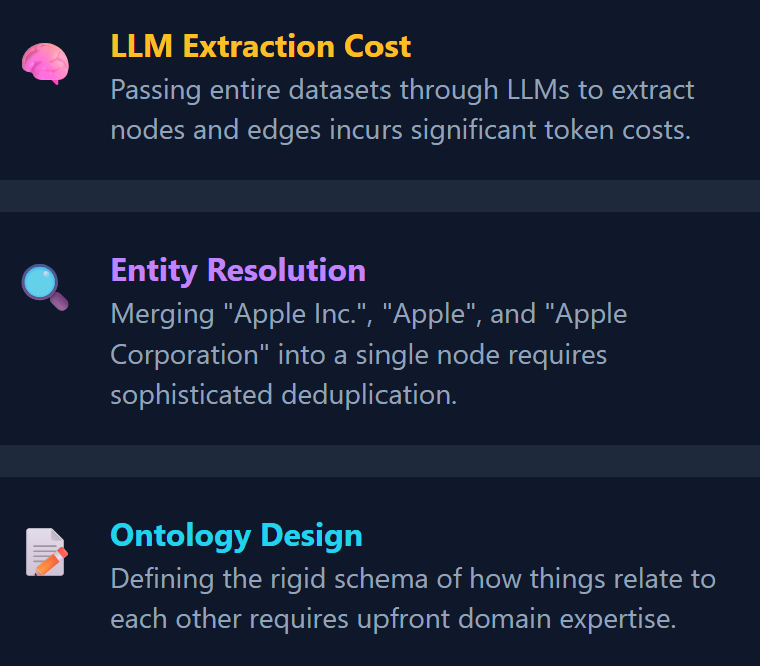
While powerful, GraphRAG is not a silver bullet. The primary bottleneck is building and maintaining the Knowledge Graph itself. Extracting entities and relationships accurately from messy, unstructured text is computationally expensive and logically complex.

Real-World Implementation
Implementing GraphRAG requires a multi-stage pipeline. We move from raw unstructured text to a structured graph, and finally combine graph traversal with semantic search for the ultimate query response.

Tools & Ecosystem
The tooling landscape is rapidly evolving. Frameworks are abstracting the complexity of LLM extraction, while traditional Graph Databases are adding vector search capabilities to become hybrid engines.

Find more details https://twirltech.in/2026/04/graphrag-2/